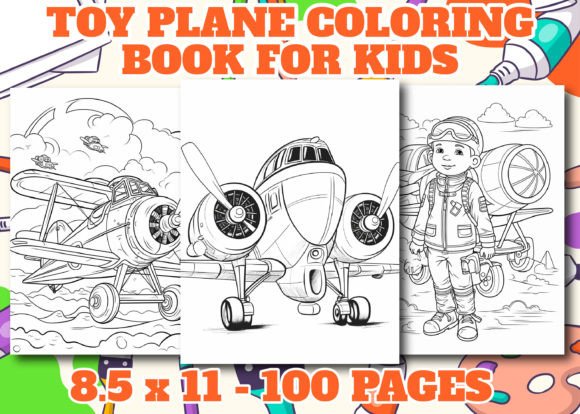
Toy Plane Coloring Pages for Kids
Toy Plane Coloring Pages for Kids is a purpose-built digital asset pack designed specifically for creators entering or scaling within the Amazon KDP and print-on-demand (POD) ecosystem. Unlike generic coloring page collections, this set focuses tightly on a single, high-engagement theme—airplanes as playful, imaginative toys—while delivering production-ready files that meet industry standards for commercial use. It’s not just another bundle of clipart-style illustrations; it’s a cohesive, technically sound resource built for efficiency, scalability, and audience resonance.
What Makes This Set Stand Out in Practice
The value begins with resolution and format discipline: every design is delivered at 300 DPI, sized to A4 (8.5” × 11”), and provided in three complementary formats—JPG, PNG, and AI. That tri-format structure supports multiple workflows. JPGs work reliably for quick interior PDF assembly in KDP; PNGs preserve transparent backgrounds for layered layouts or custom cover composites; AI files allow vector-based resizing, cropping, or stylistic adjustments without quality loss—critical when adapting pages for different age groups or product lines (e.g., toddler-friendly thick outlines vs. detailed versions for older children).
The inclusion of 50 unique designs avoids visual fatigue across a full-coloring-book interior. Each illustration features clean line art, consistent stroke weight, and intentional negative space—traits that support both hand-drawn coloring and digital coloring app compatibility. There are no pixelated edges, inconsistent linework, or poorly spaced elements that would require cleanup before publishing. In real-world KDP uploads, this translates directly to fewer file rejections, faster approval cycles, and reduced post-upload troubleshooting.
Practical Usability Across Publishing Workflows
For KDP authors building themed activity books, Toy Plane Coloring Pages for Kids integrates smoothly into existing design pipelines. The .zip delivery includes a ready-to-use cover image—professionally composed, centered, and sized for KDP’s 8.5” × 11” paperback spec—eliminating one common bottleneck. Users can import individual PNGs into Canva, Affinity Publisher, or Adobe InDesign and align them precisely using built-in grid tools. Because all files share the same aspect ratio and bleed-safe margins, batch-processing interiors remains predictable and repeatable.
From a POD perspective, the set performs well beyond KDP. The high-resolution JPGs render clearly on platforms like Etsy Print, Redbubble, or Gelato when adapted for posters, notebooks, or greeting cards. Educators repurposing pages for classroom handouts benefit from the crisp 300 DPI output—no blurring when printed on standard school printers. Small business owners creating branded summer camp activity kits can insert their logo into the corner of a PNG file and export instantly, without degrading detail.
Who Benefits Most—and How
This resource serves creators who prioritize execution speed without sacrificing quality. Freelance designers building client-facing activity books find the AI files especially valuable—they can adjust line thickness, recolor outlines, or combine elements with client-supplied assets without starting from scratch. Bloggers and educators developing supplemental learning materials (e.g., “Aviation-Themed STEM Activities for Early Learners”) use the pages as visual anchors in printable PDF guides—adding simple text prompts like “Draw your own airport” or “Color the parts of the plane” directly onto the PNG layers.
Small publishers targeting niche markets—such as aviation hobbyist parents, Montessori-aligned curricula, or bilingual early-learning resources—appreciate the thematic focus. A collection centered on toy planes avoids the overused “animal alphabet” or “generic vehicle” tropes, helping titles stand out in search results and browse categories. When paired with strong metadata (“toy airplane coloring book,” “kids aviation activity pages,” “airplane-themed preschool PDF”), these pages support organic visibility without relying solely on paid ads.
Consistency, Flexibility, and Long-Term Utility
Consistency across the 50 designs is evident in spacing, scale, and visual hierarchy. Planes appear at varied angles (front, side, top-down), some with wheels extended, others mid-air—but all maintain proportional balance and legible contours. No design feels rushed or underdeveloped. This uniformity matters when readers flip through a 100-page book: subtle inconsistencies in line weight or object placement create subconscious friction, reducing perceived professionalism.
Flexibility comes from format diversity and intentional simplicity. The line art avoids excessive internal detail (e.g., no tiny rivets or cockpit dials), making it accessible for ages 3–8 while still offering enough structure for fine motor development. Users report successfully scaling individual pages down to 6” × 9” for pocket-sized travel books or up to 12” × 18” for wall posters—without visible aliasing or distortion—thanks to the vector AI source files.
Realistic Considerations and Limitations
While the set excels in technical execution, it does not include editable text layers, pre-formatted PDF interiors, or instructional content. Users expecting plug-and-play, fully laid-out manuscripts will need to invest time in typesetting or hire a formatter. Similarly, there are no alternate versions (e.g., grayscale-only variants or simplified outlines for toddlers)—so creators targeting very specific developmental stages may need to modify files manually or supplement with additional assets.
Also worth noting: the theme, while focused, may limit cross-category appeal. A general “transportation” coloring book might perform more broadly than an airplane-only version—unless positioned intentionally (e.g., “Future Pilot Activity Book” or “Aviation Enthusiast Coloring for Kids”). Success depends on accurate audience targeting and complementary marketing—not just the asset quality itself.
Strategic Recommendations for Creators
For KDP newcomers, start with a 24-page low-content version using 20 of the JPG files, add a title page and simple intro, and test pricing at $5.99–$7.99. Monitor sales velocity and customer feedback before expanding to larger editions. Seasonal timing helps: launching near National Aviation Day (August 19) or during summer travel months increases relevance.
Experienced publishers can layer this set into broader product ecosystems—for example, pairing it with a companion “Airplane Word Search & Mazes” interior or bundling it with a printable paper-plane craft template. The AI files also support derivative works: trace a plane outline, convert it to a stencil SVG for Cricut users, or isolate wings/propellers for flashcard sets.
Finally, retain the original AI files long-term. Vector sources enable future updates—say, adding speech bubbles (“Wheee!”), integrating brand colors, or generating animated versions for digital learning platforms. That adaptability extends the set’s usable lifespan far beyond a single KDP upload.
In summary, Toy Plane Coloring Pages for Kids delivers what working creators actually need: precision-engineered files, thoughtful thematic cohesion, and format versatility—all grounded in real-world publishing constraints. It won’t replace strategy or audience research, but it removes friction where many projects stall: sourcing reliable, rights-cleared, production-ready illustrations. For anyone building activity-based digital or print products, it’s a pragmatic, reusable foundation—not just another download.