150 Baby Wild Animals Coloring Pages
If you're looking for a versatile, production-ready coloring resource that works across multiple creative and commercial needs — from self-publishing to classroom use, therapy tools to gift shop inventory — 150 Baby Wild Animals Coloring Pages is built to deliver without compromise. It’s not just another bundle of line art; it’s a thoughtfully assembled, print-optimized toolkit designed for real-world application.
What You’re Actually Getting (Beyond the Numbers)
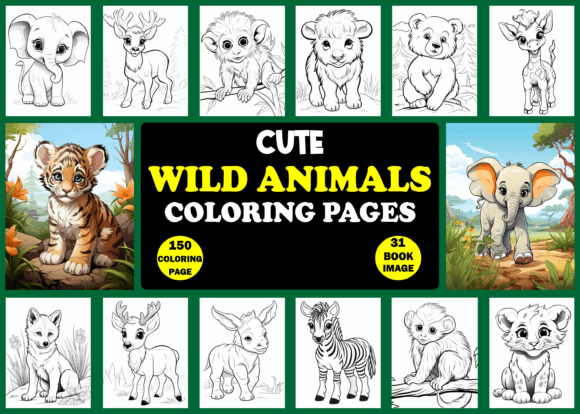
Yes — there are 150 pages. But what matters more is how those pages function in practice. Each illustration features baby wild animals — think wide-eyed fox kits, tiny orangutan infants, curious baby sloths, miniature snow leopards, and tender sea otter pups — drawn with clean, confident lines that hold up beautifully at scale. They’re black-and-white, high-contrast, and intentionally designed for coloring by hand or digital stylus.
The package includes three full sets: 150 PDFs (print-ready, 8.5″ x 11″), 150 JPGs (ideal for digital platforms or quick previews), and 150 PNGs (with transparent backgrounds, perfect for overlays, app integration, or custom layout work). All files are rendered at 300 DPI — no pixelation, no blurry edges, no last-minute scaling stress when preparing for KDP or local print shops.
Where This Bundle Fits Into Real Creative Workflows
Here’s where 150 Baby Wild Animals Coloring Pages becomes more than a download — it becomes a working asset:
- KDP Authors & Self-Publishers: Launch a themed coloring book in under 48 hours. The included 31 PNG book cover options (also 300 DPI) let you test variations fast — soft pastel background? Jungle foliage border? Minimalist typography overlay? Resize freely without quality loss. Many creators pair this set with a short intro page (“Meet the Babies!”) and a fun facts section to boost perceived value.
- Educators & Homeschoolers: Use individual pages during animal life cycle units, habitat studies, or emotional regulation breaks. A kindergarten teacher in Oregon prints two copies of the baby panda page: one for coloring, one laminated for tracing with dry-erase markers. A homeschool parent in Tennessee uses the baby cheetah image as a springboard for a mini-research project — “How fast do baby cheetahs run at 3 months?” — then colors while discussing answers.
- Therapists & Counselors: These aren’t generic doodles — they’re emotionally resonant subjects. Baby animals naturally invite gentleness, curiosity, and care. One child life specialist uses the baby elephant page during anxiety grounding exercises (“Trace the trunk slowly — feel your breath match each curve”). Another occupational therapist layers the baby koala image into a fine-motor worksheet, adding dotted paths along the limbs for pencil control practice.
- Small-Business Owners: A boutique stationery brand in Colorado turned five of the images into greeting cards (“Welcome Little One” + baby red panda), printed on textured paper. A children’s yoga studio in Austin projects the baby sloth page onto their wall during “slow breathing” time — no tech setup needed beyond a basic projector and a white wall.
Who Benefits Most — And Why Timing Matters
This isn’t just for people who “like coloring.” It’s for people who need reliable, adaptable, emotionally warm visuals on deadline. A freelance graphic designer building a client’s summer camp workbook doesn’t have time to commission custom illustrations — but they *do* have time to drop in 12 of these pages, add camp-themed borders, and export a polished PDF. A new mom launching an Etsy shop for printable baby shower activities grabs the baby flamingo and baby narwhal pages, adds “Name That Baby Animal!” instructions, and lists her first product before bedtime.
It also works quietly behind the scenes: interior designers sourcing playful, nature-inspired art for pediatric waiting rooms; church volunteers assembling VBS take-home packets; even indie game developers using the PNGs as base assets for low-poly animal sprites in a calming mobile app.
Things to Keep in Mind Before You Use It
While 150 Baby Wild Animals Coloring Pages covers broad ground, it helps to know its natural boundaries:
- No color guides or answer keys: These are pure line art — intentional for open-ended creativity, but not suited if you need pre-colored references or teaching aids with labeled anatomy.
- No licensing for resale as standalone digital files: You can sell printed books, physical products, or integrated digital experiences (like a coloring app with these images embedded), but you can’t resell the ZIP file itself on Gumroad or Creative Market as-is.
- Wildlife focus means limited domestic animals: You’ll find baby wolves, lynx, and manatees — but not puppies, kittens, or calves. That’s a strength if you want ecological authenticity; a limitation if your audience expects farm themes.
- All images are single-subject, centered compositions: Great for clarity and printing efficiency, but less ideal if you need complex scenes (e.g., baby animals playing together in a jungle). That said, many users combine two PNGs in Canva or Affinity Designer to build custom spreads.
Why Quality Consistency Makes a Difference
You’ll notice right away that none of the 150 pages feel like afterthoughts. There’s no sudden drop in line weight on page #87 or awkward cropping on the baby walrus. That consistency isn’t accidental — it means less time troubleshooting, fewer customer complaints about “blurry pages” on Amazon, and smoother transitions between physical and digital use cases. When a school orders 30 printed copies for a nature week, they get uniform results. When a grandparent downloads the PDF to color with their grandchild over Zoom, both screens show crisp, legible outlines — no squinting, no confusion.
Practical Next Steps — No Overthinking Required
You don’t need a business plan to benefit from 150 Baby Wild Animals Coloring Pages. Start small: pick three images that resonate with your current goal — maybe the baby snow leopard for a winter mindfulness guide, the baby octopus for an ocean unit, the baby bison for a Native American studies connection. Drop one into your document, adjust margins if needed (they’re already sized for standard US letter), and see how it feels in context.
If you're evaluating bundles for long-term use, ask yourself: Does this save me time *this week*? Does it reduce friction in my most common workflow? Does it spark ideas instead of demanding them? For hundreds of creators, educators, and small-business owners, the answer has been yes — not because it’s flashy, but because it’s solid, usable, and quietly thoughtful in its design.