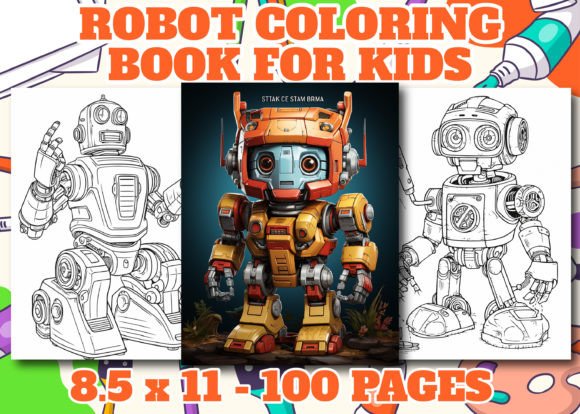
Robot Coloring Book for Kids: A High-Resolution Creative Asset for Educators, Designers, and KDP Entrepreneurs
Coloring is more than a pastime—it’s a foundational learning tool that supports fine motor development, visual discrimination, focus, and early conceptual thinking. When themed around robotics, it bridges playful engagement with emerging STEM literacy. The Robot Coloring Book for Kids stands apart not only for its thematic relevance but for its technical execution: 50 original, hand-crafted robot illustrations—each delivered in three professional-grade formats (JPG, PNG, and AI), all at 300 DPI resolution, sized to A4 (8.5” × 11”) standards, and packaged in a single downloadable .zip file. This isn’t generic clip art repackaged; it’s a purpose-built interior asset designed for real-world application across education, publishing, and print-on-demand ecosystems.
Why Resolution and Format Flexibility Matter Beyond the Page
Many coloring book collections sacrifice fidelity for convenience—offering low-res JPEGs or flattened PDFs that pixelate when scaled or edited. In contrast, the Robot Coloring Book for Kids delivers layered, production-ready files. Each of the 50 designs exists as a high-resolution JPG (ideal for immediate KDP upload), a transparent-background PNG (enabling seamless compositing into lesson plans or digital worksheets), and a vector-based AI file (Adobe Illustrator format), which retains infinite scalability without loss of clarity. That last point is critical: educators adapting pages for classroom posters, therapists customizing line weights for children with motor challenges, or designers integrating robots into themed activity kits all benefit from editable vectors—not static images.
Consider a third-grade teacher preparing a “Robots Around Us” unit. She might extract a friendly humanoid robot from the AI file, adjust stroke thickness for easier tracing, add labeled parts (“sensor,” “actuator,” “power source”), and export a new PDF for student handouts. A POD entrepreneur launching a niche “STEAM Summer Challenge” workbook could layer one of the PNGs over a watercolor texture background, then combine it with original math puzzles—all without licensing complications or quality degradation. The inclusion of a professionally designed cover image further streamlines the process, eliminating the need for separate graphic design investment before Amazon KDP submission.
Educators and Curriculum Developers
In early childhood and elementary settings, robot-themed coloring supports cross-curricular connections. Robots are tangible metaphors for systems thinking—students color moving parts while discussing cause-and-effect, sequence logic, or energy flow. Unlike abstract diagrams, these illustrations invite narrative: “What does this robot do? Where does it work? What problem does it solve?” Teachers report increased verbal elaboration and vocabulary use during coloring-based discussions. The consistent 300 DPI resolution ensures crisp projection on interactive whiteboards, and the A4 sizing aligns with standard classroom printers—no cropping or scaling guesswork required.
KDP Authors and Self-Publishing Entrepreneurs
For creators building passive income streams on Amazon KDP, interior quality directly impacts customer reviews, return rates, and long-term ranking. Blurry lines, inconsistent line weights, or cramped compositions frustrate young colorists—and prompt negative feedback. The Robot Coloring Book for Kids avoids these pitfalls through intentional design discipline: clean, bold outlines (2–3 pt minimum weight), generous white space around each figure, and balanced negative/positive space to prevent visual overwhelm. Because all 50 images are original and commercially licensed for resale, users avoid copyright takedowns—a common risk when sourcing free assets online. The bundled .zip structure also simplifies inventory management: one download replaces dozens of individual file searches.
Therapists, Homeschoolers, and Activity Designers
Occupational therapists use structured coloring to build hand strength, pencil control, and bilateral coordination. Robots—with their geometric shapes, repeating patterns (gears, circuits, panel lines), and varied complexity levels—offer natural progression: simpler wheeled bots for beginners, intricate multi-limbed models for advanced practice. The AI files allow clinicians to isolate sections (e.g., just the robot’s arm) for targeted motor drills. Similarly, homeschooling parents appreciate the thematic cohesion: a single download supports science lessons, art integration, and quiet focus time—all without subscription fees or platform lock-in.
Technical Specifications as Strategic Advantages
The stated specs—A4 (8.5” × 11”), 300 DPI, 50 unique designs—are not arbitrary benchmarks. They reflect industry-aligned production standards:
- A4 / 8.5” × 11” sizing matches Amazon KDP’s most popular paperback trim (6” × 9” interiors require cropping; 8.5” × 11” allows full bleed or safe-margin layouts without manual resizing).
- 300 DPI resolution meets KDP’s minimum requirement for print clarity and exceeds typical screen-display needs (72–150 DPI), ensuring sharp output whether printed at home, via local print shops, or through KDP’s global fulfillment network.
- JPG + PNG + AI triad covers the full workflow spectrum: JPG for fast KDP uploads, PNG for digital reuse (Google Slides, Canva, Seesaw), AI for deep customization (changing colors, adding text, combining elements).
- No watermarks, no attribution requirements—a key differentiator from many free resource libraries—grants full commercial autonomy.
This level of technical readiness reduces friction at every stage: no need to hire a designer to reformat, no delays waiting for custom vector conversion, no uncertainty about Amazon’s file validation system. It transforms what could be a weeks-long production cycle into an afternoon workflow.
Design Philosophy: Balancing Playfulness and Pedagogical Intention
Effective robot illustrations for children avoid two extremes: oversimplified cartoonishness that misses mechanical nuance, and hyper-realistic renderings that feel intimidating or abstract. The Robot Coloring Book for Kids occupies a deliberate middle ground. Designs include friendly, expressive faces on utility bots; recognizable real-world parallels (roomba-like cleaners, Mars rover-inspired explorers, assistive devices); and subtle educational cues—visible joints, labeled ports, or stylized circuit paths—without sacrificing aesthetic appeal. One page features a robot gardener with visible solar panels and seed compartments; another shows a recycling bot sorting materials with labeled bins. These aren’t decorative fillers—they’re conversation starters embedded in line art.
Line consistency is equally intentional. Every illustration uses uniform stroke weight, avoiding thin, breakable lines that vanish during printing or thick, muddy borders that bleed when colored with markers. Curves are smooth, angles precise—critical for developing spatial reasoning. And because all 50 robots are uniquely posed and proportioned (no duplicated templates), children encounter variety in scale, orientation, and complexity—mirroring real-world diversity in robotic form and function.
Implementation Pathways for Different Users
How users engage with these files depends less on the asset itself and more on their goals and tools:
- KDP Sellers: Upload JPGs directly into KDP’s interior builder; pair with the included cover for instant paperback setup. Add brief STEM prompts on select pages (“Can you draw what this robot senses?”) to increase perceived value without extra design work.
- Teachers Using Google Workspace: Insert PNGs into Google Docs or Slides, then add text boxes for labeling exercises or drag-and-drop sorting activities (e.g., “Match the robot part to its function”).
- Print Shop Partners: Use AI files to create large-format posters (24” × 36”), laminated tracing sheets, or custom flashcards—expanding revenue beyond digital marketplaces.
- Hobbyist Makers: Import AI files into Cricut Design Space or Silhouette Studio to cut robot stencils, create iron-on transfers for T-shirts, or generate wood-burned coasters—leveraging the same source files across physical product lines.
Crucially, none of these pathways require additional licensing, plugin subscriptions, or third-party conversion services. The .zip file contains everything needed—no hidden dependencies, no paywalled upgrades.
Long-Term Value Beyond First Use
Unlike disposable digital downloads, high-fidelity, multi-format creative assets compound in utility over time. A single set of 50 robot illustrations can fuel multiple publications: a standalone coloring book, a “Robot Facts & Fun” activity journal, a bilingual edition (adding Spanish labels to AI files), or even a companion sticker sheet (exporting PNGs at smaller sizes). Educators reuse them year after year across grade levels—simplifying lesson prep while maintaining freshness through new applications. For business owners, the ability to rapidly test sub-niches (“Robot Pets,” “Underwater Robots,” “Space Robots”) using the same foundational art library lowers experimentation risk and accelerates iteration.
In essence, the Robot Coloring Book for Kids functions less like a finished product and more like a versatile creative substrate—one that adapts to evolving pedagogical approaches, shifting marketplace demands, and expanding technical capabilities. Its strength lies not in novelty alone, but in its thoughtful alignment with how people actually teach, learn, publish, and make.