Robot Coloring Pages for Kids
Robot Coloring Pages for Kids is a professionally curated digital asset pack designed specifically for creators building printable activity books, educational resources, or themed merchandise. Unlike generic clipart collections or low-resolution web downloads, this set delivers consistent, print-ready artwork optimized for commercial use—especially within Amazon KDP and print-on-demand (POD) workflows. Its value lies not in novelty alone, but in execution: high-fidelity files, thoughtful design cohesion, and structural compatibility with standard publishing requirements.
What Makes These Robot Coloring Pages Stand Out?
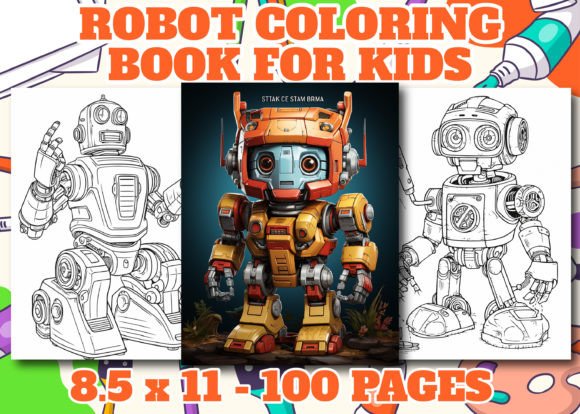
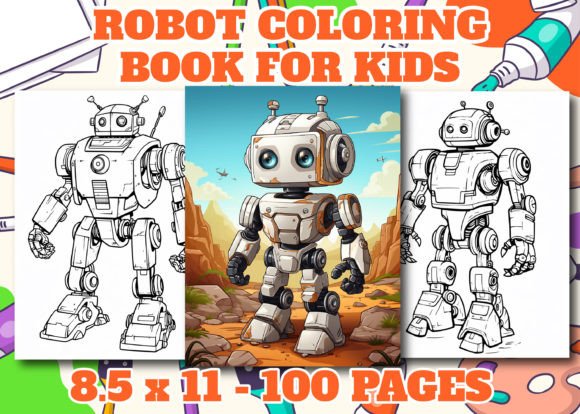
The collection includes 50 original robot-themed illustrations—each hand-drawn with clean linework, balanced negative space, and age-appropriate complexity. These aren’t photorealistic renderings or overly technical schematics; they’re stylized, friendly, and intentionally scalable. That balance matters: younger children need clear outlines and uncluttered shapes to color confidently, while older kids benefit from subtle details like gear patterns, panel lines, or expressive eyes that invite creativity without frustration.
All designs are delivered at 300 DPI resolution in A4 (8.5” × 11”) dimensions—the industry standard for U.S. and international print compatibility. This eliminates guesswork when preparing interiors for KDP paperback or hardcover books. No upscaling artifacts, no pixelation at print size—just reliable fidelity straight from the .zip file.
File Format Flexibility Supports Real-World Workflows
The package includes three essential formats for each illustration: JPG, PNG, and AI (Adobe Illustrator). That triad covers most production needs:
- JPG files serve as lightweight, universally compatible assets for quick interior layout in Canva, Microsoft Word, or KDP’s online editor.
- PNG files provide transparent backgrounds—useful when layering robots over custom backgrounds, adding borders, or designing themed covers and marketing thumbnails.
- AI files offer full vector scalability and editable paths. Designers can adjust stroke weight, recolor elements, or isolate components (e.g., swapping antennae styles or modifying wheel designs) without quality loss.
A single high-resolution cover image is also included—designed to match the interior aesthetic, with appropriate typography spacing and bleed-ready margins. It’s not just decorative; it functions as a cohesive branding anchor across your product line.
Practical Performance in KDP and POD Environments
In real-world KDP testing, these Robot Coloring Pages for Kids consistently produce crisp, legible interiors when converted to PDF using standard export settings (e.g., Adobe Acrobat’s “Press Quality” preset). The line thickness averages 1.2–1.8 pt—thick enough to survive minor printer calibration drift, yet fine enough to retain detail. That consistency reduces customer complaints about faint or broken outlines—a common pain point with low-DPI or poorly traced assets.
For POD sellers, the A4 sizing aligns cleanly with both U.S. letter and international A4 trim options. Resizing is possible—but rarely necessary. When adjustments are needed (e.g., fitting a 6×9 interior), the vector AI files allow proportional scaling without distortion, preserving stroke integrity better than raster-only alternatives.
Who Benefits Most—and How?
This resource suits several professional use cases:
- KDP publishers building themed activity books—especially those bundling robots with science, coding, or STEM concepts. The designs support cross-curricular alignment without requiring custom illustration budgets.
- Educators and homeschoolers creating supplemental materials. Teachers report higher engagement when coloring pages reflect familiar themes (like robots) alongside vocabulary prompts or simple engineering questions added in post-production.
- Freelance designers developing white-label products for clients. The AI files let them adapt robots to match brand colors, add client logos, or integrate into larger illustrated scenes—without redrawing from scratch.
- Small business owners launching merch lines (stickers, tote bags, notebooks). PNGs with transparency simplify mockup creation in tools like Placeit or Smartmockups, cutting down on design time per SKU.
It’s less suited for users needing photorealistic robotics, licensed character derivatives, or ultra-minimalist line art for advanced art therapy applications. The style is accessible—not experimental—and prioritizes usability over avant-garde expression.
Quality Control and Long-Term Usability
Each illustration was reviewed for line continuity, closed path integrity, and uniform stroke behavior—critical for auto-tracing or Cricut/Silhouette cutting files (though not included here, the vector foundation supports such adaptation). There are no duplicated silhouettes; robots vary in pose (standing, floating, crouching), orientation (front, side, three-quarter), and feature emphasis (some highlight arms, others focus on treads or cockpit windows). This variety helps avoid visual fatigue across multi-page books.
The .zip delivery structure is logical: clearly labeled folders (JPG/, PNG/, AI/, Cover/), no nested subfolders or placeholder files. File names follow a consistent numbering convention (Robot_01.png, Robot_02.ai), making batch import into design software or DAM systems straightforward.
Realistic Considerations and Limitations
While the set excels in technical readiness, it doesn’t include editable text layers, pre-formatted KDP templates, or instructional content. Users must supply their own pedagogical framing, branding language, or layout expertise. Likewise, there’s no licensing for resale as standalone digital files—only for inclusion in physical/digital end products like printed books or downloadable PDFs.
Coloring page effectiveness also depends on audience context. For children under five, some designs may still require adult guidance due to small enclosed areas (e.g., rivet clusters or joint mechanisms). Pairing select pages with simplified versions—or using the AI files to manually thicken key outlines—is a practical adjustment many experienced creators make.
Final Assessment: A Reliable Foundation, Not a Finished Product
Robot Coloring Pages for Kids functions best as a production-grade component—not a turnkey solution. Its strength is reliability: predictable output, format versatility, and stylistic coherence across 50 pieces. For someone building their third or fourth KDP activity book, that consistency saves hours in asset sourcing, troubleshooting, and revision cycles. For a new POD seller, it lowers the barrier to launching a technically sound first title without investing in custom illustration.
If your workflow involves regular creation of themed printable content—and you prioritize clean lines, commercial licensing clarity, and format flexibility—this set delivers measurable efficiency gains. It won’t replace strategic planning or audience research, but it removes one layer of execution risk. And in fast-moving digital marketplaces, reducing friction at the asset level often translates directly to faster iteration, clearer testing, and more confident scaling.